
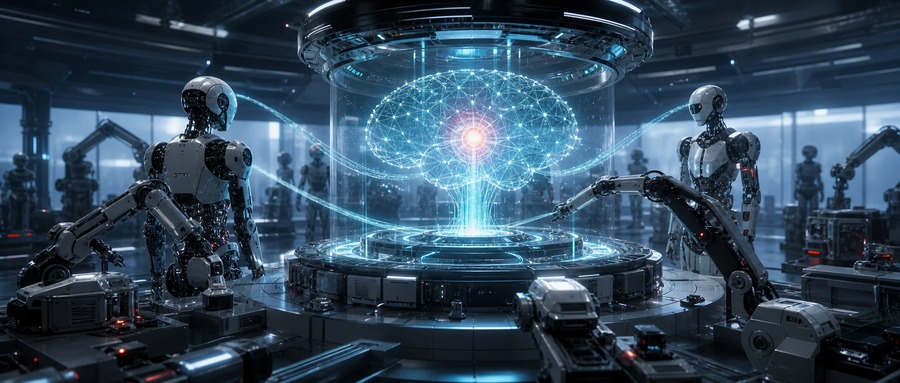
The Race for Robot Brains: Who Will Become the “Android” of Physical AI?
The robotics industry is shifting from “building bodies” to “building brains.”
In recent years, humanoid robots, quadruped robots, warehouse robots, and service robots have continuously redefined what robot hardware can do: who walks more steadily, who runs faster, whose hands are more dexterous, whose price is lower. But as robots move into real factories, warehouses, commercial services, and capital markets, the industry is awakening to a more fundamental question: the real gap in robotics may not be in the body, but in the brain.
Chinese companies’ actions illustrate this shift. AgiBot’s open-source project has published over 1 million real robot trajectories covering 217 tasks across five deployment scenarios, aiming to train general-purpose manipulation capabilities with real-world data. After Unitree Robotics’ STAR Market IPO registration was approved, reported fundraising purposes include advancing robot AI models, hardware R&D, new product development, and smart manufacturing base construction. In other words, Chinese robotics companies are no longer just emphasizing low-cost hardware and mass production — they are extending into the models, data, and intelligence layers of Physical AI.
The so-called robot “brain” is not a voice assistant or a single algorithm. It is a comprehensive system capability that enables robots to understand tasks, perceive environments, plan actions, invoke tools, continuously learn, and safely execute. It encompasses vision-language-action (VLA) models, simulation training platforms, real robot data, motion control, task planning, edge computing, and developer ecosystems.
The Center of Gravity Is Moving Upward
Early robotics competition revolved around hardware performance. Humanoid robots competed on degrees of freedom, battery life, and dexterous hands; warehouse robots on handling efficiency and fleet management; service robots on navigation, obstacle avoidance, and interaction quality.
But Physical AI follows a different logic. Robots are no longer just automation equipment — they are AI’s physical interface with the real world. They need to complete open-ended tasks in real environments: understand objects, comprehend instructions, determine task sequencing, know what can be grasped and what cannot, and self-correct when encountering anomalies.
This is shifting the robotics value chain upward. Hardware remains important, but without a generalizable “brain,” robots can only repeat fixed routines. With a transferable, learnable, deployable “brain,” robots can evolve from single-purpose devices into general-purpose productivity terminals.
NVIDIA: Building the Infrastructure for the Robotics Era
If there is one company closest to being the “foundational platform” of the Physical AI era, it is NVIDIA. NVIDIA does not primarily rely on selling any specific robot — it aims to be the infrastructure provider for robot development, training, simulation, and deployment.
Its Isaac GR00T platform is officially defined as an open reference platform for general-purpose humanoid robots, encompassing open data and data pipelines, robot foundation models, simulation frameworks built on Omniverse and Cosmos, middleware, CUDA-X runtime libraries, and the Jetson Thor edge computing module for real-time inference and control.
The strategic significance of this ecosystem is that it does not solve for any single robot motion — it addresses industry-wide challenges: where data comes from, how simulation is done, how models are trained, how deployment is verified, and how edge inference connects to cloud training.
Model Companies: Competing for the General-Purpose Brain
Beyond NVIDIA’s infrastructure play, several companies are competing directly at the model layer to become the “universal brain” for robots.
Google DeepMind has released Gemini Robotics, a VLA model built on the Gemini architecture, designed to enable robots to understand natural language instructions, perceive visual scenes, and generate action sequences. Google’s advantage lies in its massive multimodal data foundation and world-class AI research capabilities.
Physical Intelligence, a startup focused on building general-purpose robot brains, has published its π0.5 model, demonstrating cross-embodiment generalization — the ability to transfer learned skills across different robot platforms. The company raised significant funding and represents the emerging “model-first” approach to robotics.
Skild AI, another U.S.-based startup, completed a Series C round and is focused on building foundation models for physical intelligence. Its approach emphasizes scalability and generalization across tasks and environments.
What these model companies share is a common ambition: they do not necessarily need to build the best robot hardware themselves — they want to use cross-embodiment, cross-scenario, cross-task models to become the intelligence layer behind different robot manufacturers.
Physical AI Key Players and Positions
| Type | Key Players | Core Capabilities | Challenges |
|---|---|---|---|
| Compute & Toolchain Platform | NVIDIA Isaac GR00T | Simulation, training, edge deployment, developer ecosystem | Still needs hardware partners and scenario customers for deployment |
| Foundation Model Companies | Google DeepMind, Physical Intelligence, Skild AI | VLA models, task planning, cross-embodiment generalization | Real robot data scarcity, long scenario validation cycles |
| China Hardware & Data Route | AgiBot, Unitree, and others | Real-world scenarios, hardware scale, data loop potential | Model platformization, developer ecosystem, and interface standards need maturation |
| Scenario Entry Companies | Warehouse, manufacturing, service robot companies | Customer sites, operational data, continuous maintenance | Whether data can consolidate into general-purpose capability remains unproven |
The China Route: Real Scenarios and Data Loops
Chinese robotics companies’ advantage lies not primarily in foundation model starting points, but in real-world scenarios and hardware scale. China has dense manufacturing, warehousing, logistics, commercial service, and public space environments, along with a rapidly iterating robot hardware supply chain.
As long as robots can enter real environments, companies have the opportunity to accumulate vast amounts of motion data, failure data, maintenance data, and scenario adaptation experience. The value of AgiBot World lies in pushing robot data from lab demonstrations to multi-scenario, reusable, verifiable data assets.
However, the China route also faces challenges. Real data locked within individual companies has limited value; only by forming unified interfaces, training tools, model platforms, and developer ecosystems can real data become an industry platform.
There Won’t Be Just One “Android for Robots”
Drawing an analogy between robot platforms and “Android” is instructive, but the differences must also be acknowledged. Phone hardware form factors are relatively standardized, while robots come in bipedal, wheeled, quadruped, articulated arm, dexterous hand, and mobile base forms — with different degrees of freedom, sensors, payloads, and working environments.
When a phone app crashes, the worst case is a force quit. When a robot motion fails, it can damage equipment, disrupt production, or even create physical safety risks. Therefore, the platformization difficulty for robot “brains” is far higher than for mobile internet. The “Android” of the Physical AI era cannot be just a software system — it must simultaneously encompass safety control, hardware adaptation, simulation verification, version management, log tracing, scenario testing, and accountability boundaries.
The more likely outcome is multiple layers coexisting: NVIDIA mastering compute and toolchains, Google DeepMind, Physical Intelligence, and Skild AI competing at the model layer, and Chinese hardware and scenario companies accumulating real-world data and deployment capabilities.
Bot Telegraph Assessment
Bot Telegraph assesses that the “brain” competition of the Physical AI era will determine future profit distribution across the robotics value chain. In the short term, hardware companies will remain the most closely watched, because they can showcase products, secure orders, and enter factories and capital markets. In the medium term, the real differentiation will emerge in models, data, simulation, and development platforms. In the long term, whoever can form a cross-embodiment, cross-task, cross-scenario robot intelligence layer may become the infrastructure company of the Physical AI era.
It is too early to declare who will become the sole “Android for robots.” The robotics world will likely not have just one operating system, but rather a multi-layer ecosystem: foundational compute platforms, model platforms, data platforms, hardware platforms, and scenario platforms coexisting. What truly matters is who can connect these layers together.
The next phase of the robotics industry is not just about “who builds robots,” but “who teaches robots to work.” The core competition of the Physical AI era is not about making robots more human-like, but about giving robots brains that can transfer, evolve, and scale.
Note: This article is an industry research observation and does not constitute investment advice.
Main Sources
• AgiBot World: Public materials and papers on the million-level real robot trajectory dataset.
• NVIDIA Isaac GR00T official materials.
• Google DeepMind Gemini Robotics official materials and related papers.
• Skild AI Series C funding announcement.
• Physical Intelligence public materials and π0.5 related papers.
• Reuters coverage of Unitree Robotics STAR Market IPO registration approval.