Core Judgment: Automakers entering the robotics field is not a simple case of cross-industry trend-chasing, but a natural extension of the intelligent vehicle industry towards Physical AI. They simultaneously possess transferable perception and control technologies, complex machinery mass-production capabilities, and the factory scenarios most suitable for the initial deployment of robots.
Over the past few years, a clear phenomenon has emerged in the humanoid robot track: the most active participants are not just robotics startups and internet giants, but also an increasing number of automotive companies.
Tesla continues to advance Optimus and has begun building a production line at its Fremont factory. XPeng plans to drive the mass production of its advanced humanoid robot IRON by the end of 2026. Hyundai Motor Group, leveraging Boston Dynamics’ Atlas, plans to deploy it in phases in US auto factories starting in 2028 and aims to achieve an annual production capacity of 30,000 robots by 2028. Although BMW and Mercedes-Benz have not directly entered the whole-machine manufacturing arena, they have partnered with Figure AI and Apptronik, respectively, to introduce humanoid robots into automotive production processes.
Why are automakers flocking into the robotics industry? One important reason is that the technological boundary between intelligent vehicles and intelligent robots is becoming blurred.
The Technological Boundary is Becoming Blurred
Today’s intelligent vehicles are no longer just traditional means of transportation; they are large-scale robots operating in the real physical world. They need to perceive the environment through cameras, radar, and sensors, rely on computing platforms and AI models to understand the road, and then complete actions through steering, braking, and power systems. Humanoid robots similarly need to solve problems of perception, decision-making, control, and execution, except that cars move on roads, while robots also need to perform walking, grasping, and manipulation.
Therefore, the visual perception, data loops, AI chips, world models, and motion control capabilities that automakers have accumulated in autonomous driving can be transferred to robots to a certain extent. XPeng explicitly incorporates vehicles, Robotaxis, and humanoid robots into its Physical AI system, and its IRON also reuses some AI capabilities from the intelligent vehicle domain.
Automakers Excel at Mass-Producing Complex Machines
However, technology reuse is only the first layer of reasons. The more prominent advantage of automakers is that they possess the capability to mass-produce complex machines.
A humanoid robot comprises motors, reducers, sensors, batteries, controllers, structural components, and numerous wiring harnesses. Its complexity shares significant overlap with the new energy vehicle supply chain. Automotive companies have already established supplier management, quality inspection, cost control, and large-scale production systems—capabilities that are the hardest for robotics startups to quickly develop.
Hyundai Motor Group believes its automotive-grade design capabilities, component systems, and manufacturing network can help Boston Dynamics commercialize Atlas. Tesla is also attempting to rebuild supply chains for motors, gears, sensors, and dexterous hands for Optimus. Elon Musk recently acknowledged that mass-producing humanoid robots might be one of the most difficult manufacturing challenges Tesla has ever faced.
Auto Factories are the Training Ground for Robots
More crucially, automakers themselves possess the most realistic initial application scenarios for robots—their own auto factories.
Compared to homes, the environment of an automotive production line is more stable, tasks are easier to define, and the return on investment is easier to calculate. Robots can start with tasks like component handling, material sorting, loading/unloading, and repetitive assembly, collecting data, identifying faults, and improving products in real production.
BMW disclosed that Figure 02 worked approximately 1,250 hours at its Spartanburg plant in the US, handling over 90,000 parts and participating in the production of more than 30,000 BMW X3 vehicles. BMW subsequently continued to introduce Figure 03 and is building Physical AI software and data capabilities at its German factories.
This means that auto factories are not only potential customers for robots but also serve as “training grounds” for automakers to train their robots. Automakers can first validate safety, reliability, and cost-effectiveness internally before considering expansion into external manufacturing, logistics, and service industries.
From Growth Curves to the Commercialization Test
Of course, automakers entering the robotics field also involves deeper strategic considerations. Competition in the new energy vehicle industry is intensifying, and relying solely on vehicle sales for growth is becoming increasingly difficult. Autonomous driving, Robotaxis, and robots are becoming important directions for automakers to find their next growth curve.
But this does not mean that all automakers can smoothly complete the leap from “building cars” to “building humans.”
Humanoid robots need to solve problems like dexterous hands, movement on complex terrain, long-term reliable operation, and generalization in open environments. These difficulties cannot be simply solved by automotive technology. Automotive production lines also already employ numerous robotic arms and specialized automation equipment. Humanoid robots will only give customers a reason to purchase them if they demonstrate clear advantages in flexibility, deployment cost, and task-switching capability.
Therefore, automakers entering the robotics industry does not mean that humanoid robots have reached the stage of full commercialization. The more realistic path currently remains to first complete validation within their own factories, starting with a small number of fixed and repetitive tasks, and gradually accumulate operational data.
Bot Telegraph Judgment
Automakers flocking into the robotics field is essentially not a simple case of cross-industry trend-chasing, but a natural extension of the automotive industry towards Physical AI following its intelligentization.
They possess transferable perception and control technologies, mature supply chains for motors, batteries, and components, and the factory scenarios most suitable for the initial deployment of robots. These conditions make automakers among the few participants in the humanoid robot industry capable of simultaneously providing technology, manufacturing, data, and customers.
However, the true advantage of automakers lies not in unveiling a walking robot, but in whether they can stably produce robots like they manufacture cars and prove their value at the workstation.
From building cars to “building humans,” the hardest part is not crossing the product boundary, but truly transforming the scale capabilities accumulated by the automotive industry into productivity that robots can continuously deliver.
Bot Telegraph Commentary
Focusing on the global robotics industry, embodied intelligence, and manufacturing sites, recording key changes from automotive intelligentization to the implementation of Physical AI.
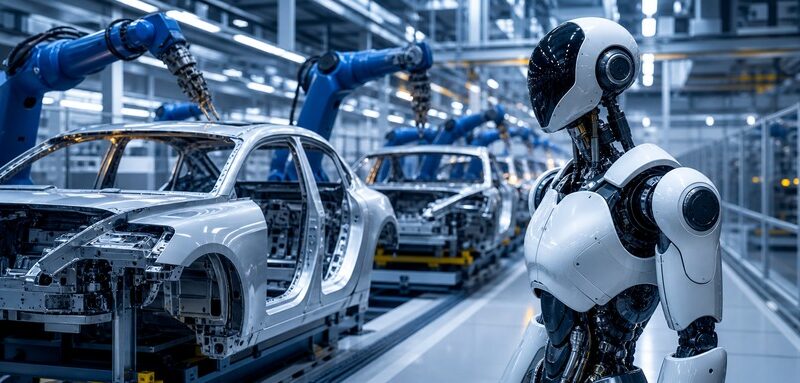

Core Judgment: Automakers entering the robotics field is not a simple case of cross-industry trend-chasing, but a natural extension of the intelligent vehicle industry towards Physical AI. They simultaneously possess transferable perception and control technologies, complex machinery mass-production capabilities, and the factory scenarios most suitable for the initial deployment of robots.
Over the past few years, a clear phenomenon has emerged in the humanoid robot track: the most active participants are not just robotics startups and internet giants, but also an increasing number of automotive companies.
Tesla continues to advance Optimus and has begun building a production line at its Fremont factory. XPeng plans to drive the mass production of its advanced humanoid robot IRON by the end of 2026. Hyundai Motor Group, leveraging Boston Dynamics’ Atlas, plans to deploy it in phases in US auto factories starting in 2028 and aims to achieve an annual production capacity of 30,000 robots by 2028. Although BMW and Mercedes-Benz have not directly entered the whole-machine manufacturing arena, they have partnered with Figure AI and Apptronik, respectively, to introduce humanoid robots into automotive production processes.
Why are automakers flocking into the robotics industry? One important reason is that the technological boundary between intelligent vehicles and intelligent robots is becoming blurred.
The Technological Boundary is Becoming Blurred
Today’s intelligent vehicles are no longer just traditional means of transportation; they are large-scale robots operating in the real physical world. They need to perceive the environment through cameras, radar, and sensors, rely on computing platforms and AI models to understand the road, and then complete actions through steering, braking, and power systems. Humanoid robots similarly need to solve problems of perception, decision-making, control, and execution, except that cars move on roads, while robots also need to perform walking, grasping, and manipulation.
Therefore, the visual perception, data loops, AI chips, world models, and motion control capabilities that automakers have accumulated in autonomous driving can be transferred to robots to a certain extent. XPeng explicitly incorporates vehicles, Robotaxis, and humanoid robots into its Physical AI system, and its IRON also reuses some AI capabilities from the intelligent vehicle domain.
Automakers Excel at Mass-Producing Complex Machines
However, technology reuse is only the first layer of reasons. The more prominent advantage of automakers is that they possess the capability to mass-produce complex machines.
A humanoid robot comprises motors, reducers, sensors, batteries, controllers, structural components, and numerous wiring harnesses. Its complexity shares significant overlap with the new energy vehicle supply chain. Automotive companies have already established supplier management, quality inspection, cost control, and large-scale production systems—capabilities that are the hardest for robotics startups to quickly develop.
Hyundai Motor Group believes its automotive-grade design capabilities, component systems, and manufacturing network can help Boston Dynamics commercialize Atlas. Tesla is also attempting to rebuild supply chains for motors, gears, sensors, and dexterous hands for Optimus. Elon Musk recently acknowledged that mass-producing humanoid robots might be one of the most difficult manufacturing challenges Tesla has ever faced.
Auto Factories are the Training Ground for Robots
More crucially, automakers themselves possess the most realistic initial application scenarios for robots—their own auto factories.
Compared to homes, the environment of an automotive production line is more stable, tasks are easier to define, and the return on investment is easier to calculate. Robots can start with tasks like component handling, material sorting, loading/unloading, and repetitive assembly, collecting data, identifying faults, and improving products in real production.
BMW disclosed that Figure 02 worked approximately 1,250 hours at its Spartanburg plant in the US, handling over 90,000 parts and participating in the production of more than 30,000 BMW X3 vehicles. BMW subsequently continued to introduce Figure 03 and is building Physical AI software and data capabilities at its German factories.
This means that auto factories are not only potential customers for robots but also serve as “training grounds” for automakers to train their robots. Automakers can first validate safety, reliability, and cost-effectiveness internally before considering expansion into external manufacturing, logistics, and service industries.
From Growth Curves to the Commercialization Test
Of course, automakers entering the robotics field also involves deeper strategic considerations. Competition in the new energy vehicle industry is intensifying, and relying solely on vehicle sales for growth is becoming increasingly difficult. Autonomous driving, Robotaxis, and robots are becoming important directions for automakers to find their next growth curve.
But this does not mean that all automakers can smoothly complete the leap from “building cars” to “building humans.”
Humanoid robots need to solve problems like dexterous hands, movement on complex terrain, long-term reliable operation, and generalization in open environments. These difficulties cannot be simply solved by automotive technology. Automotive production lines also already employ numerous robotic arms and specialized automation equipment. Humanoid robots will only give customers a reason to purchase them if they demonstrate clear advantages in flexibility, deployment cost, and task-switching capability.
Therefore, automakers entering the robotics industry does not mean that humanoid robots have reached the stage of full commercialization. The more realistic path currently remains to first complete validation within their own factories, starting with a small number of fixed and repetitive tasks, and gradually accumulate operational data.
Bot Telegraph Judgment
Automakers flocking into the robotics field is essentially not a simple case of cross-industry trend-chasing, but a natural extension of the automotive industry towards Physical AI following its intelligentization.
They possess transferable perception and control technologies, mature supply chains for motors, batteries, and components, and the factory scenarios most suitable for the initial deployment of robots. These conditions make automakers among the few participants in the humanoid robot industry capable of simultaneously providing technology, manufacturing, data, and customers.
However, the true advantage of automakers lies not in unveiling a walking robot, but in whether they can stably produce robots like they manufacture cars and prove their value at the workstation.
From building cars to “building humans,” the hardest part is not crossing the product boundary, but truly transforming the scale capabilities accumulated by the automotive industry into productivity that robots can continuously deliver.
Focusing on the global robotics industry, embodied intelligence, and manufacturing sites, recording key changes from automotive intelligentization to the implementation of Physical AI.