
WAIC Watch: How Far Away Is the Robotics “ChatGPT Moment”?
At the World Artificial Intelligence Conference (WAIC), judging whether a robot is “smart” is far more difficult than judging whether it can simply move.
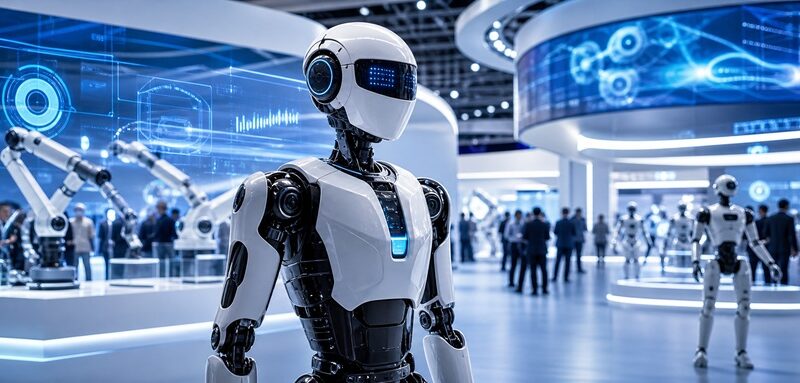
In the exhibition hall, humanoid robots turn and wave their arms to the music; quadruped robots navigate steps and ramps; dual-arm robots grasp products and organize parts; retail robots shuttle between shelves and counters. Onlookers raise their phones, and every time a robot completes an action, a round of applause echoes through the venue.
However, standing in front of the booth, one crucial question often goes unanswered: Does the robot actually understand the task and execute the movement autonomously, or is it being remotely controlled by staff behind the scenes? Is an AI model making real-time decisions based on the environment, or are these just pre-programmed routines? When an error occurs during operation, can it recover on its own, or does it require manual intervention?
Relying solely on a smooth demonstration video, the outside world finds it difficult to find answers.
This is the most easily overlooked dividing line in the current robotics boom: the ability to move does not equate to autonomy; completing a task once does not mean the robot has truly learned the job.
One Robot, Three Ways of “Working”
The robotic movements observed by Bot Telegraph at the exhibition generally stem from three control methods.
The first is pre-programming. Engineers preset motion trajectories, execution sequences, and trigger conditions in advance, and the robot executes them repeatedly according to the program. Performances like dancing, waving, and walking along fixed routes can largely be achieved this way.
The second is teleoperation. Staff use controllers, motion capture equipment, VR headsets, or master-slave robotic arms to map human movements onto the robot. Although a robot may appear to autonomously brew tea, grasp objects, or transport items, there is likely a human making real-time judgments and controlling it from behind the scenes.
The third method is the autonomous operation pursued by embodied AI: the robot perceives its environment through cameras and force sensors, understands natural language tasks, autonomously breaks down steps and plans movements, and continuously adjusts based on on-site changes.
There is no simple distinction between good and bad among these three methods. Pre-programming is stable and reliable, making it ideal for structured production lines; teleoperation can handle complex tasks and serves as a vital tool for collecting robot training data; model autonomy represents stronger generalization capabilities, but it remains the most challenging path today.
WAIC even featured a highly intuitive case of “cross-city teleoperation.” A robot demonstrated by Realman Intelligent was controlled in real-time by an operator at a Beijing training center to complete the steps of warming cups, dropping tea leaves, pouring water, and serving tea at the Shanghai booth. The company hopes to accumulate real-world operational data through this process to use for model iteration. This case illustrates that teleoperation is not merely a transitional solution; it can serve as foundational infrastructure for remote operations and data generation.
Therefore, teleoperation itself is not the issue. The real question is whether companies clearly inform the audience which actions are human-controlled, which are executed via pre-programmed routines, and which are genuinely driven by autonomous models.
Why Robots Haven’t Had Their ChatGPT Moment Yet
The impact of ChatGPT did not lie in computers being able to generate text for the first time, but rather in the fact that ordinary people no longer needed to learn programming. They only needed to make requests in natural language to gain relatively stable capabilities covering a vast array of tasks.
Similarly, the “ChatGPT moment” for robotics should not merely be defined by a single robot performing a highly difficult action. At the very least, it means that a user can assign a previously unprogrammed task using natural language, and the robot can understand its environment, break down the steps, execute them autonomously, and adapt its plan when unexpected events occur.
Currently, most robots remain noticeably far from this goal.
Haixing Zhang, former head of the Tesla China Design Center and founder of Matrix Superintelligence, categorizes embodied AI into stages L1 to L5. L1 involves remote control and pre-programmed actions; L2 involves specific scenario skills like brewing tea or retail services; L3 begins to learn new tasks through language and human demonstrations; the final stage is the autonomous discovery and resolution of problems. He estimates that the industry is currently transitioning from L1 to L2 and L3.
This assessment aligns with observations at the WAIC venue. Robots can already grasp drinks, parts, or daily necessities at fixed booths, but whether their existing capabilities remain effective when shelf layouts are altered, objects are swapped, or disturbances are introduced typically requires further verification.
Cheng Qin, CEO of Qtron, also believes that the true test of whether embodied AI has arrived is not how flashy a demo is, but whether the robot can break free from teleoperation to complete a full closed loop of perception, planning, and execution in a physical environment.
Robots Face a “Physical Wall” That Large Models Don’t
Language models can draw massive amounts of text, images, and code from the internet, but robots do not have access to an equivalent scale of ready-made data.
Teaching a robot to grasp a cup requires recording camera footage, joint positions, end-effector trajectories, gripping force, and task outcomes. If the size, material, or position of the cup changes, the original actions may fail. Because different robots possess varying degrees of freedom, sensors, and control interfaces, it is difficult to directly apply the same dataset universally.
Yonglu Li, an associate professor at Shanghai Jiao Tong University, revealed that after screening approximately 120,000 hours of first-person human behavior data, his team found that fewer than 5,000 hours were actually usable for pre-training Vision-Language-Action (VLA) models. Yongtao Huang, Chief Data Scientist at Ant Lingbo Technology, pointed out that teleoperation data also suffers from alignment issues regarding the learning targets, task distribution, and different robot embodiments.
At the WAIC Embodied AI Forum, Maoqing Yao from Agibot summarized the industry’s bottlenecks as three “walls”: data, representation, and closed loops. High-quality real-world interaction data is scarce, unified representation across tasks, scenarios, and embodiments is not yet mature, and trial-and-error in the real world is both expensive and slow to provide feedback.
This represents the biggest difference between the developmental paths of robotics and ChatGPT.
If a large language model gives a wrong answer, it can simply regenerate it; if a robot fails to grasp an object, it might break it. Large models can train on countless tasks simultaneously on servers, whereas robotic data usually requires physical devices to execute tasks one by one. A wrong word in language generation has limited consequences, but an incorrect physical action can disrupt an entire production process.
Autonomous Capabilities Are Emerging, But With Conditions
Progress is definitely being made toward robotic autonomy.
Google DeepMind’s Gemini Robotics 1.5 has already attempted to enable robots to plan tasks before execution, breaking down longer tasks into multiple shorter steps. Its official documentation also indicates that the model can transfer certain capabilities between different robotic forms—for instance, movements learned on a dual-arm platform could potentially be transferred to a humanoid robot.
This year, Figure AI demonstrated Helix 02 controlling a humanoid robot to complete dishwasher loading and unloading tasks. According to the company, the robot continuously executed for about 4 minutes, completing 61 actions—including walking, picking up, placing, and opening and closing cabinet doors—without any teleoperation or human intervention. It is worth noting, however, that this was a technology demonstration in a specific environment, and achieving stable replication in open environments still requires further verification. Nevertheless, it clearly highlights the developmental trajectory for long-sequence autonomous tasks.
At WAIC, some companies explicitly emphasized “zero teleoperation.” Keenon Robotics stated that the humanoid robots operating in their retail, coffee, dessert, and laundry scenarios are driven entirely by their self-developed models. For such demonstrations, the metrics worth observing going forward are not just one-off successes, but task success rates, continuous operation times, performance under environmental changes, and the frequency of manual takeovers.
The “ChatGPT Moment” Won’t Arrive for All Robots at Once
The industry does not have a unified answer as to when embodied AI will experience its “ChatGPT moment.”
Xingxing Wang, founder of Unitree Robotics, estimated this year that it will take two to three years; at related WAIC forums, participants’ predictions generally ranged from two to five years.
However, it is necessary to distinguish between two types of “moments.”
The first is an industrial breakthrough: in structured environments like factories, warehouses, and retail, robots can receive tasks via natural language, operate autonomously amidst a certain range of variables, and minimize the need for human intervention. This stage may emerge within the next two to three years.
The second is the general-purpose robot of public imagination: a single machine entering an unfamiliar home, understanding the environment like a human, cooking, doing laundry, tidying up rooms, caring for the elderly, and autonomously learning new tasks. Because home environments are highly unstructured and tasks are complex—with much higher demands for dexterous manipulation and safety—this goal will likely take much longer to achieve.
Therefore, the “ChatGPT moment” for robotics will probably not arrive overnight like a software product. It is more likely to first appear in a single warehouse, at a specific workstation, or in a local store, before gradually expanding to cover more tasks.
Exhibitions Need an “Autonomy Specification Sheet”
Bot Telegraph believes that observing robots in the future requires looking beyond what actions they complete, and strictly questioning how those actions are completed.
Exhibition booths should provide clearer labels: Is the demonstration teleoperated, pre-programmed, or model-autonomous? What is the robot’s success rate for completing the task? How often, on average, is manual intervention required? Are the environment and object positions randomized? Can the robot recover independently after a failed action?
These metrics may not be as visually captivating as dancing or doing backflips, but they better reflect whether a robot is truly approaching its “ChatGPT moment.”
Today’s robots already possess increasingly agile physical bodies and are forming rudimentary capabilities in vision, language, and action. However, the transition from “following human commands” to “understanding human intent,” and from “repeating a single action” to “autonomously completing a category of tasks,” still involves overcoming multiple hurdles related to data, models, reliability, and cost.
The excitement at the WAIC venue is not an illusion; it showcases an industry advancing rapidly. But what is truly worth waiting for is not the next smoother performance video, but the day when people no longer need to pre-program a robot’s movements or hide behind a screen to control it.
When that day comes, faced with a simple command like “tidy this place up,” a robot will be able to assess the environment first and decide where to begin.
That will perhaps be the true ChatGPT moment for robotics.
Source: Bot Telegraph China