
Bot Telegraph Commentary | Dissecting Unitree G1: Japan Sees More Than Just a Robot
Core Judgment: When Japanese engineers disassembled Unitree’s G1, they saw more than just a humanoid robot capable of performing tricks; they saw a maturing set of capabilities in engineering, productization, and supply chain management. What truly deserves attention is not a simplistic China-Japan victory assessment, but the fact that Chinese robotics companies have advanced from “demonstrable” to “purchasable, disassemblable, and open for secondary development.”
This statement can easily be interpreted as the Japanese robotics industry “admitting defeat.” However, what truly merits discussion is not an emotional China-Japan victory assessment, nor whether a single robot leads in all metrics, but rather what the Japanese side observed after opening the casing: a transformed capability within the Chinese robotics industry.
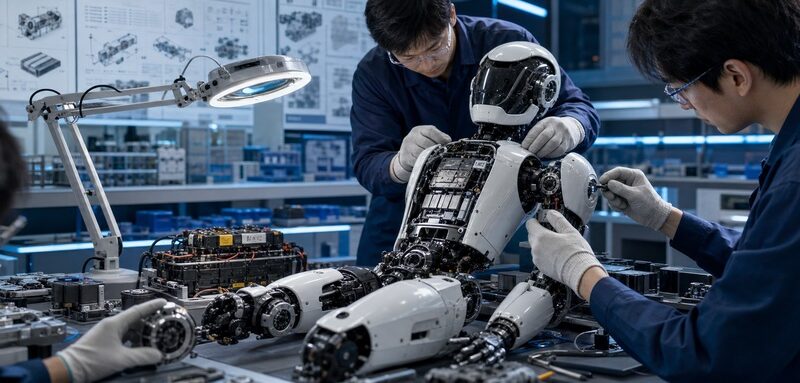
Tumbling, dancing, and martial arts moves on stage can be achieved through motion control algorithms and preset programs; disassembly, however, confronts a different set of metrics that are harder to fake: how joint modules are arranged, how wiring harnesses thread through tight spaces, how batteries enable quick removal, how structures are lightened, whether components are easy to source, and whether the entire machine can be reliably assembled, maintained, and mass-produced.
In this sense, what was disassembled was not just a G1, but a cross-section of the Chinese humanoid robot industry’s transition from technological demonstration to engineering, productization, and platformization.
Disassembly is Closer to Industry Truth than Performances
According to public reports, Nikkei xTECH published a disassembly video of the Unitree G1 on July 23 and plans to release a dedicated analysis report. The engineers involved focused on observing the design of joint modules, wiring harness layout, lightweight structures, batteries, and leg mechanisms, ultimately concluding that Chinese humanoid robots are no longer confined to the concept and demonstration stage. It should be noted that this assessment comes from a media disassembly and its participants, and does not represent the official conclusion of the entire Japanese robotics industry. However, the signal it sends is still worth noting.
A robot’s ability to perform complex movements first indicates that its body control and mechanical structure have reached a certain level. However, a robot’s ability to be sold, disassembled, modified, and used for secondary development reflects a more complete product capability.
Unitree’s official overseas store currently lists the G1 at $13,500 USD. The product page lists configurations including 23 to 43 joints, force-controlled dexterous hands, and support for imitation learning and reinforcement learning. This is not a prototype confined to a laboratory, but a robot platform openly sold for research, development, and application markets.
Price alone cannot prove technological leadership, nor does a low price mean the product is already suitable for all industrial scenarios. The G1 still has areas requiring improvement, such as battery life, payload capacity, dexterous manipulation, and long-term reliability. However, its most significant meaning is transforming humanoid robots, previously accessible only to a few large laboratories, into products that more universities, startups, and development teams can purchase, modify, and train.
This is akin to the early changes in the personal computer and smartphone industries: what truly drives industry proliferation is not necessarily a single performance metric reaching its peak, but rather products becoming accessible, iterative, and capable of fostering a developer ecosystem.
The Gap Felt by the Japanese Side is First and Foremost Engineering Speed
Waseda University developed WABOT-1 as early as 1973, and later Honda’s ASIMO became one of the most iconic humanoid robots globally. Japan also possesses industrial robot companies like FANUC, Yaskawa Electric, and Kawasaki Heavy Industries, with deep accumulations in servo systems, precision reducers, bearings, sensors, manufacturing quality, and reliability engineering.
The issue is that Japan’s early humanoid robots primarily served technological demonstration, corporate image, and scientific verification functions, without being widely transformed into openly sold, general-purpose platforms. IEEE Spectrum, in its observation of this year’s Humanoids Summit in Tokyo, noted that the number of Chinese robots present was approximately three times that of Japanese robots, with some Japanese companies even using Chinese robots for their own technology demonstrations. The report also mentioned that the Japanese company GMO AI & Robotics is collaborating with Japan Airlines to test air cargo handling tasks using a modified G1.
This change carries symbolic significance.
Over twenty years ago, global companies were studying Japanese humanoid robots; today, Japanese developers are beginning to purchase Chinese robots, installing dexterous hands, computing platforms, cameras, and sensors on them to validate their own models and applications.
What the Japanese side truly feels is perhaps not “Japan cannot build robots,” but that Chinese companies are faster at bringing products to market: first creating a sellable body, then continuously identifying issues through customers, developers, and real-world scenarios; iterating hardware while expanding production volume, and then using more devices to generate training data.
This is a typical engineering competition. It does not require the first-generation product to be perfect, but demands that companies can quickly complete the cycle of “design—production—sales—feedback—improvement.”
Behind the G1 is Supply Chain Density, Not a Single Mysterious Technology
Disassembling a robot also serves another important purpose: determining whether its competitiveness stems from some difficult-to-replicate “black technology” or from the efficient combination of numerous mature technologies.
Based on existing public disassembly materials, not every component of the G1’s joints, sensors, batteries, and structural parts is irreplaceable. What is truly difficult to replicate quickly is more likely the system integration, hardware-software co-design, motion control experience, and the engineering trade-offs made for cost and mass production.
This is also key to understanding China’s manufacturing advantage. Industrial competition is not always determined by the most advanced individual component, but by the ability to find a commercially viable balance between performance, cost, weight, delivery time, and maintainability.
China has formed the world’s largest industrial robot application market. Data from the International Federation of Robotics shows that in 2024, China installed 295,000 industrial robots, accounting for 54% of global new installations; China’s industrial robot stock exceeds 2 million units, approximately 4.5 times that of Japan. The share of Chinese domestic manufacturers in new domestic installations also rose to 57% for the first time.
Industrial robots and humanoid robots are not the same market, but the manufacturing foundation has a transmissive effect. Dense automated production lines, mechanical processing enterprises, motor and drive suppliers, electronic manufacturing systems, and a large number of application customers provide a space for trial and error for humanoid robots.
Unitree’s advantage is therefore not just a specific motion algorithm, nor just a joint module, but its position within an industrial network where components, engineers, processing capabilities, testing environments, and potential customers can be quickly found.
If Japan only replicates the G1’s mechanical structure, it cannot naturally replicate this network.
The Three Shifts Behind the Disassembly Event
From an industrial perspective, this event reflects at least three shifts.
First, Chinese robots are transitioning from “being watched” to “being studied.” In the past, overseas markets primarily learned about Chinese robots through dances, competitions, and demonstration videos; now, foreign engineers are beginning to purchase and disassemble Chinese products, studying their structure, cost, and engineering approach.
Second, Chinese robots are transitioning from “catch-up products” to “reference platforms.” Japanese companies using the G1 in their own application tests indicates that Chinese bodies are beginning to serve as platforms for overseas developers to integrate software, sensors, and scenario solutions.
Third, robotics competition is shifting from single-point technology to industrial systems. Japan possesses advantages in precision manufacturing and traditional robotics, the US holds advantages in foundational models and computing power, and China has formed a strong combination in body manufacturing, supply chain, scenarios, and cost control. Future victories will not be determined by any single country or company relying solely on a single capability.
Bot Telegraph Judgment
When Japanese engineers disassembled Unitree’s G1, they saw more than just a humanoid robot capable of walking and performing tricks.
They saw that Chinese robotics companies have reached a point where they can integrate joints, controllers, batteries, sensors, and algorithms into a marketable product. They saw a supply chain that continuously drives down product costs. They also saw an increasing number of robots entering universities, laboratories, factories, and the hands of overseas developers, forming new cycles of data collection and iteration.
For Japan, closing this gap in the short term is indeed not easy. What needs to be caught up with is not a single parameter or a prototype, but an entire ecosystem encompassing productization speed, supply chain density, and market feedback mechanisms.
However, Chinese companies are also not yet in a position to declare victory lightly. True industrial leadership is not just about others admiring clever design after disassembly; it is about the robot, once reassembled, being able to work stably over the long term in real-world scenarios and create calculable value for customers.
The disassembly proves that Chinese robots have moved beyond the stage of “only being able to demonstrate.”
The next test is whether they can continue past the stage of “being purchasable” and ultimately reach the stage of “being worthy of long-term use.”
Bot Telegraph Commentary
Focusing on the global robotics industry, embodied intelligence, and manufacturing sites, documenting key transitions from the laboratory to the production line, and from demonstration to productization.
Source: Bot Telegraph China