
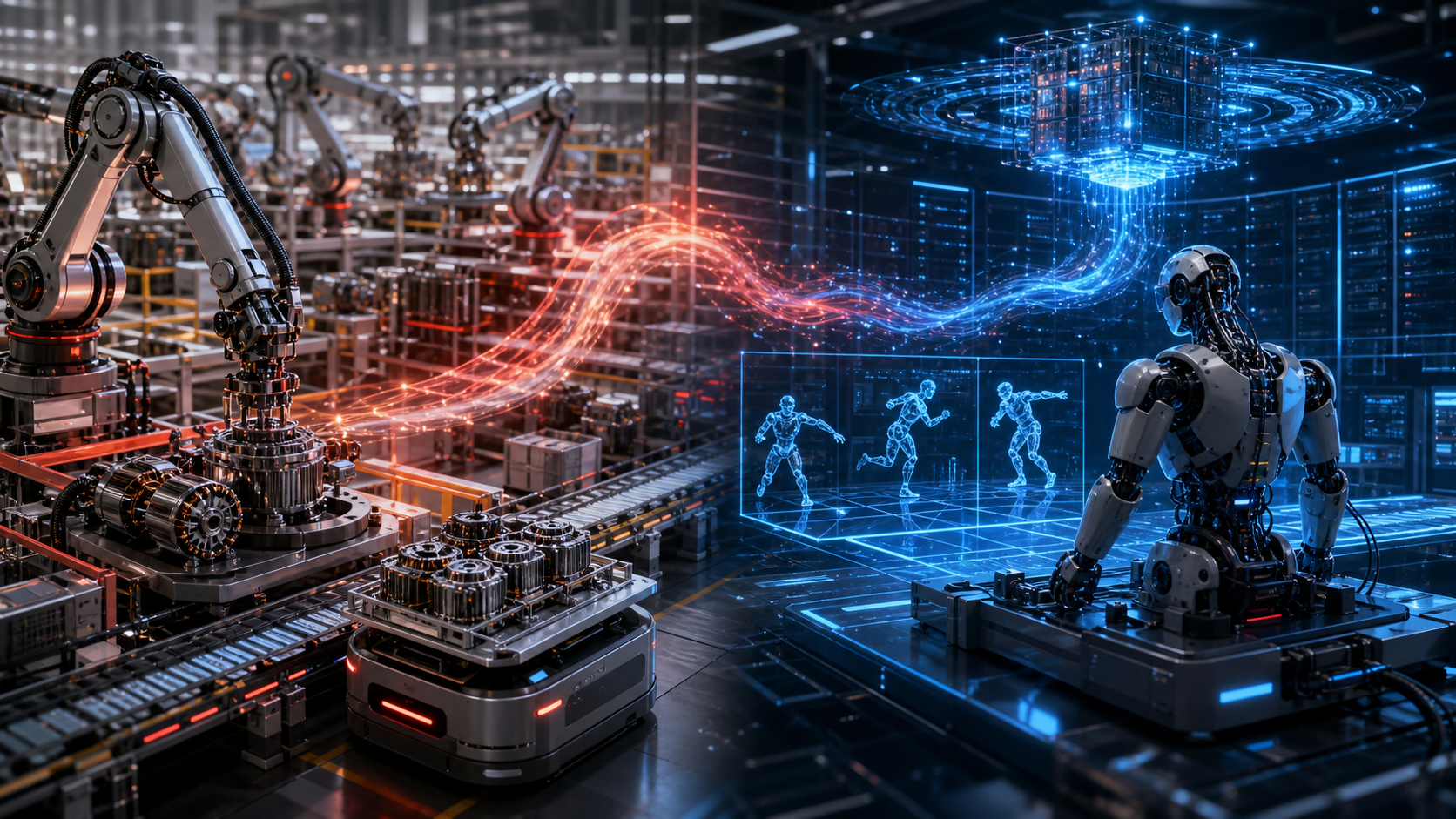
China and U.S. Robotics Supply Chains Race Ahead: Manufacturing Loops vs. Intelligent Platforms
As the robotics industry enters a capital market pricing window, the supply chain is becoming a key variable in observing the Sino-US competition. Unitree Technology’s approved STAR Market IPO registration, Agility Robotics’ planned SPAC merger, Figure AI’s validation in BMW factories, and NVIDIA’s continuous enhancement of its Physical AI platform all point to the same question: whether future robotics companies can win depends not merely on whether their robots ‘can move,’ but on whether the underlying components, manufacturing, data, models, and scenarios can form a closed loop.
Overall, the Chinese robotics supply chain excels in its manufacturing system, component support, cost control, and application scenario density; the United States leads in AI chips, foundation models, simulation platforms, software ecosystems, and high-value enterprise clients. The competition between the two nations is not a simple matter of ‘who is ahead and who is behind,’ but rather a clash of two supply chain paradigms: one excels at building, delivering, and continuously reducing the cost of robots; the other excels at defining the underlying platform for robotic intelligence and pioneering entry into high-end validation scenarios.
According to data from the International Federation of Robotics (IFR) report ‘World Robotics 2025,’ there were 542,000 new industrial robot installations globally in 2024, with China installing 295,000 units, accounting for 54% of the global total. China’s operational stock of industrial robots exceeded 2 million units, with local manufacturers capturing 57% of the domestic market share for the first time. The US accounted for approximately 6% of global industrial robot installations in 2024; based on the global figure of 542,000 units, US new installations are estimated at around 32,500 units.
Figure 1: Comparison of new industrial robot installations in China and the US in 2024. Source: IFR ‘World Robotics 2025’; US figures are estimated based on global share.
China’s Supply Chain: Forming a Rapid Iteration Closed Loop from Whole Machines to Components
The biggest characteristics of China’s robotics supply chain are its ‘completeness’ and ‘speed.’ A robot involves servo motors, reducers, encoders, controllers, sensors, batteries, structural parts, wiring harnesses, chips, algorithms, software, and whole-machine manufacturing. Driven by the accumulated experience in new energy vehicles, consumer electronics, drones, lithium batteries, and automation equipment industries, China’s supporting capabilities in joint modules, dexterous hands, lightweight structural parts, motors, batteries, and final assembly have significantly strengthened.
Humanoid robots particularly highlight this advantage. They are not the result of a single technological breakthrough, but the systemic integration of motors, reducers, sensors, structural parts, AI algorithms, and manufacturing processes. Foreign media recently observing China’s dexterous hand industry pointed out that Chinese companies are leveraging their mature manufacturing supply chain—especially the spillover from the new energy vehicle industry chain—to accelerate the mass production of dexterous hand hardware. However, the real challenge has shifted from ‘building a hand’ to acquiring tactile data, software training, and complex manipulation capabilities.
On the policy side, initiatives are also pushing the supply chain into real-world scenarios. The Ministry of Industry and Information Technology (MIIT) and the State-owned Assets Supervision and Administration Commission (SASAC) have launched actions related to real-world training for humanoid robots and embodied AI. The core logic is to accumulate data, optimize algorithms, and verify component reliability through real-world scenario training, thereby propelling robots from prototype testing to large-scale deployment. For China’s robotics industry, the scenarios themselves are becoming an integral part of the supply chain.
However, the shortcomings of China’s supply chain are equally clear. A robot cannot function simply by stacking components together; what truly determines commercialization is task understanding, path planning, dexterous manipulation, exception recovery, safety control, and system operations and maintenance (O&M). While China has a distinct advantage in hardware supply chain, it still needs to catch up in high-end robotics software, foundation models, industrial-grade reliability, international safety standards, and developer ecosystems.
US Supply Chain: Thinner Hardware Manufacturing Base, but Strong ‘Brain’ and Platform Capabilities
The structure of the US robotics supply chain differs from that of China. The US boasts globally leading AI chips, cloud computing, simulation platforms, robotic foundation models, autonomous driving technologies, and high-end robotics companies. Centered around Physical AI, NVIDIA has built robot training and deployment platforms such as Cosmos, Isaac, and GR00T, emphasizing the introduction of intelligent robots into real industrial environments through simulation, world models, robotic foundation models, and ecological partnerships.
From a technology stack perspective, the US robotics industry resembles an ‘AI platform-driven supply chain.’ Behind companies like Tesla Optimus, Figure AI, Agility Robotics, Apptronik, Boston Dynamics, Physical Intelligence, and Skild AI, what capital markets truly value is not just the robot body, but the vision-language-action (VLA) models, simulation training, data closed loops, general control capabilities, and enterprise-grade application interfaces.
The US advantage is also reflected in high-value scenarios. Industries such as logistics, automotive manufacturing, defense, healthcare, energy, and warehousing are willing to pay a premium for safe, reliable, and auditable robotic systems. Unlike Chinese companies, which emphasize rapid cost reduction and scale, US companies often start with validation in high-value clients and controlled scenarios before gradually expanding deployment.
However, the US supply chain also has obvious shortcomings. The Information Technology and Innovation Foundation (ITIF) recently pointed out that although the US invented the industrial robot, it now accounts for only 5.4% of global robot exports, possesses less than 10% of the global operational stock of industrial robots, and lacks domestic ‘foundry-level’ enterprises for whole-body industrial robot manufacturing. The Association for Advancing Automation (A3) has also called for the establishment of a national robotics strategy to coordinate industrial, national security, and innovation policies.
Comparison of Core Segments
Whole Machine Manufacturing
China: Large number of enterprises, fast product iteration, and strong manufacturing organization and cost control capabilities.
US: Top companies have strong technologies, but large-scale manufacturing capabilities are relatively dispersed.
Competitive Implication: China is more suited for rapid scaling, while the US is better suited for high-end validation.
Joints, Actuators, Structural Parts
China: Benefiting from the NEV, consumer electronics, and machining systems, offering significant room for cost reduction.
US: Strong high-end design and control capabilities, but higher manufacturing costs.
Competitive Implication: In the mass production phase, China’s cost advantage is more pronounced.
Dexterous Hands and Tactile Technology
China: Rapid hardware capacity expansion and fast price reduction, but software training remains a challenge.
US: Deep accumulation in algorithms, simulation, tactile research, and control methods.
Competitive Implication: Dexterous manipulation determines whether humanoid robots are genuinely useful.
AI Chips and Computing Power
China: Abundant application scenarios, but high-end GPUs and ecosystems remain externally constrained.
US: Companies like NVIDIA control the core platforms and development ecosystems.
Competitive Implication: The US controls the ‘brain’ infrastructure of robotics.
Simulation and Foundation Models
China: Fast catch-up speed, with high potential in real-world scenario data.
US: Leading in foundation models, simulation training, and data platforms.
Competitive Implication: The competition is shifting from the hardware chain to the data and model chains.
Application Scenarios
China: Dense concentration in manufacturing, warehousing, inspection, and public scenarios, with rapid piloting speed.
US: High per-customer value in advanced manufacturing, logistics, healthcare, and defense.
Competitive Implication: China holds the scale advantage, while the US excels in per-customer value.
Policy Organization
China: More concentrated industrial policies and local scenario openness.
US: High marketization and capital efficiency, but national strategic coordination is still catching up.
Competitive Implication: China emphasizes industrial mobilization, while the US focuses on innovation platforms.
Trend Forecast: Supply Chain Upgrading from ‘Hardware Chain’ to ‘Integrated Software, Hardware, and Data Chain’
Over the next three to five years, the Sino-US robotics supply chain competition will not merely revolve around ‘whose robot is more human-like,’ but will center on actuators, dexterous hands, real-world data, simulation platforms, manufacturing yields, and large-scale delivery. The supply chain is upgrading from a traditional ‘hardware component chain’ to an integrated supply chain comprising ‘hardware + software + data + scenarios.’
First, actuators and dexterous hands will become the core battleground. McKinsey divides the core hardware stack of humanoid robots into segments such as actuators, perception systems, computing and control, structural components, and batteries, noting that actuators can account for 40% to 60% of a humanoid robot’s BOM cost. This explains why dexterous hands, joint modules, and high-precision transmission parts are heating up in China: once robots truly enter factories, the most critical factor is not ‘being able to walk,’ but whether they can stably grasp, transport, assemble, inspect, and operate tools.
Second, mass production capabilities will shift from a launch event capability to a supply chain capability. In China, Unitree Technology’s IPO registration has been approved, with funds intended to be raised for robot AI models, hardware R&D, new products, and the construction of intelligent manufacturing bases. Zhiyuan Robotics (AgiBot) announced that its 15,000th embodied intelligence robot has rolled off the assembly line, demonstrating that Chinese companies are making ‘volume delivery’ a core competitive metric. In the US, Agility Robotics plans to go public via a SPAC and disclosed that its next-generation Digit v5 has secured over $300 million in multi-year orders. Meanwhile, Figure AI is validating humanoid robots in automotive manufacturing scenarios through its project at the BMW Spartanburg plant.
Third, simulation, training data, and robotics foundation models will become the new bottlenecks. Hardware can be rapidly replicated, but robot skills cannot be simply copied. NVIDIA’s enhancement of its Cosmos, Isaac, and GR00T platforms is essentially turning robot training, simulation, data generation, and deployment tools into underlying infrastructure. Apptronik is collaborating with Google DeepMind to build a robotics training center, focusing on collecting large-scale real-world data to transition Apollo 2 from the pilot phase to production use.
Robot Telegraph’s Verdict: Victory Lies Not in a Single Point, but in the Closed Loop
The US and Chinese robotics supply chains are not competing with the same capabilities. China excels at building robots, pushing them into real-world scenarios, and rapidly reducing costs; the US excels at defining the underlying platforms for robot intelligence and validating new paradigms among high-value customers. China’s challenge is transitioning from low-cost hardware to highly reliable systems and core software; the US challenge is moving from high-end technology and prototype validation to low-cost manufacturing and supply chain resilience.
The truly leading robotics industry chain of the future will not belong solely to the country that is ‘best at building hardware,’ nor will it belong only to the country that is ‘best at developing AI models.’ Instead, it will belong to the party capable of completing four closed loops: the core components loop, the complete machine manufacturing loop, the real-world scenario data loop, and the software platform ecosystem loop.
Main References
- IFR:World Robotics 2025 report – Industrial Robots
- ITIF:America Needs a National Robotics Strategy
- A3:A3 Releases Vision for a U.S. National Robotics Strategy
- NVIDIA:NVIDIA and Global Robotics Leaders Take Physical AI to the Real World
- McKinsey:Scaling the humanoid robotics supply chain into billion-dollar wins
- IEA:Rare Earth Elements – Executive Summary
- Public sources including Reuters, BMW Group, Agility Robotics, The Guardian, etc.
Robot Telegraph: International Communicator for the Embodied Intelligence Industry
Please follow, like, and help empower the industry’s growth
The content of this article is compiled by Robot Telegraph based on public information and is for reference only