
The Humanoid Robot Route Debate: Humanlike, or Better Suited to Work Than Humans?
Humanoid robots are becoming the most prominent symbol of the global robotics industry. But must the robots of the future necessarily look like humans? This is not a question of appearance, but a matter of industry trajectory.
Humanoid robots can walk, carry boxes, and perform complex movements at exhibitions, and they are now entering capital markets and real-world factories. Proponents argue that the human world is inherently designed for humans; if robots possess a human form, they can more easily integrate into factories, warehouses, shopping malls, hospitals, and homes. Opponents counter that the value of a robot lies not in mimicking humans, but in completing tasks in a more stable, cost-effective, and safer manner.
Robot Telegram believes that the core of this debate is not whether being humanoid is good or bad, but rather what form factor is best suited for a specific scenario. The future robotics ecosystem will not be limited to a single form: bipedal humanoids, wheeled dual-armed robots, AMRs paired with robotic arms, and specialized robots will all find their rightful places across different applications.
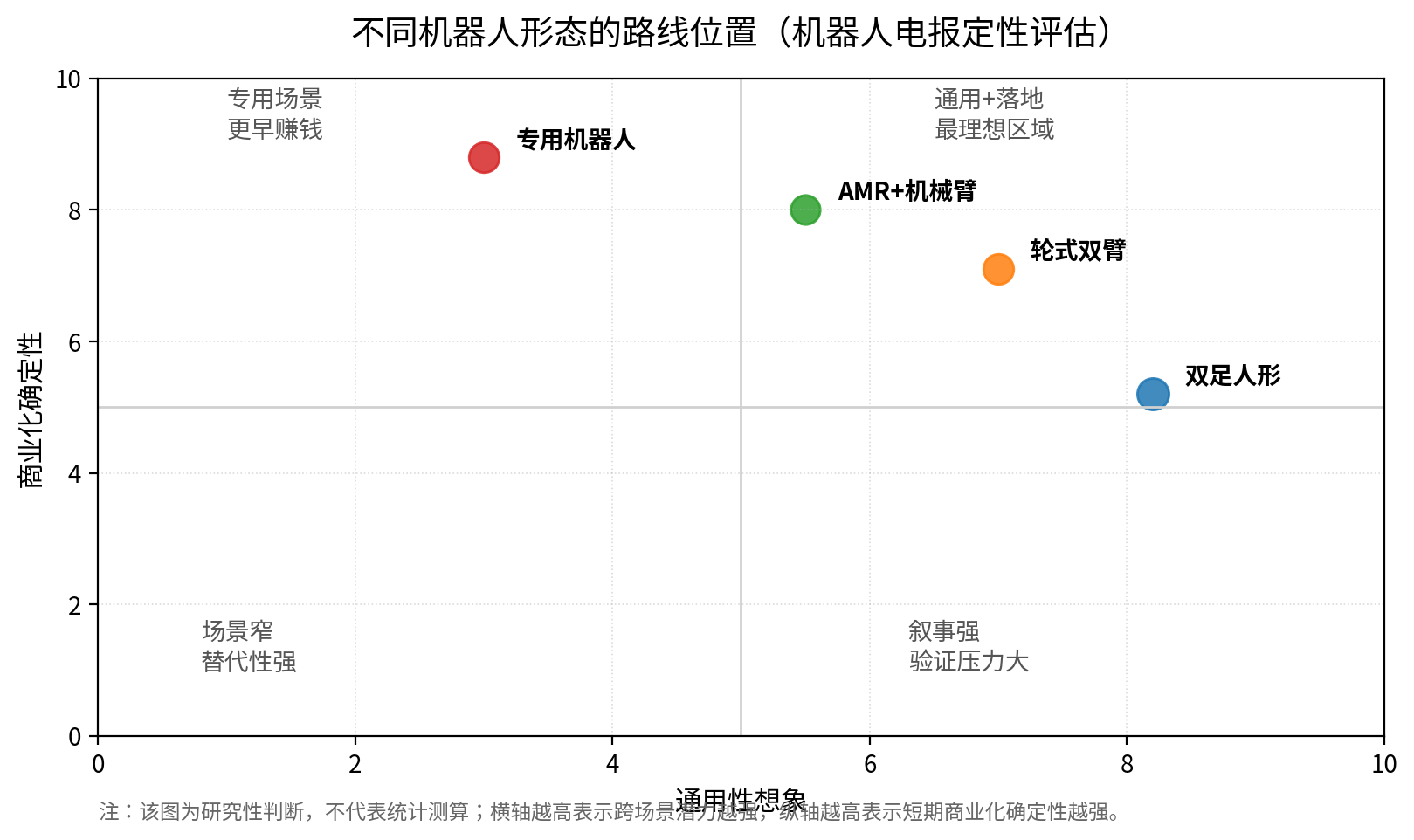
Figure 1: Positioning of Different Robotic Form Factor Trajectories (Qualitative Assessment by Robot Telegram)
Behind the Form Factor Debate Lies Trajectory Selection
The core logic supporting the humanoid trajectory is clear: stairs, door handles, shelving, tools, workshop aisles, and home spaces are predominantly designed according to human physical dimensions. If a robot possesses a human-like height, dual arms, and range of motion, it requires fewer environmental modifications and can directly use existing tools.
Figure AI provides a prime example. The company disclosed that its Figure 02 was deployed at BMW’s Spartanburg plant in the US for 11 months, operating in 10-hour shifts from Monday to Friday. It cumulatively loaded over 90,000 parts, operated for more than 1,250 hours, and participated in the production of over 30,000 BMW X3 units. Such data demonstrates that humanoid robots are no longer just trade show prototypes, but have begun undergoing real-world workstation validation in automotive manufacturing scenarios. [1]
Agility Robotics’ Digit, on the other hand, emphasizes “functional humanoid” design. An AP report indicates that Agility plans to go public via a SPAC at a valuation of approximately $2.5 billion; its robots primarily target warehousing and manufacturing scenarios, handling repetitive tasks such as moving tote boxes. Notably, Agility co-founder Jonathan Hurst emphasizes that Digit was not designed to look human; its avian-style legs and gripper hands serve specific warehousing and handling tasks. [2]
| Source of Perspectives | Implications for the Trajectory Debate |
| Rodney Brooks (MIT roboticist, co-founder of iRobot and Rethink Robotics) | questioned the assumption of “having humanoid robots take on all tasks” in his blog, arguing that today’s humanoid robots are still far from achieving true dexterous manipulation. This reminds the industry not to equate a humanoid appearance with general-purpose capabilities. [3] |
| Some Silicon Valley Investors | A Business Insider report noted that some investors believe “mimicking the human body” might impose unnecessary constraints, and that many tasks are better suited for wheeled or specialized robots. [4] |
| Jonathan Hurst (Co-founder of Agility Robotics) | Although Digit is classified as a humanoid robot, its design does not pursue a human-like appearance. Instead, it makes trade-offs centered around warehousing and handling functions, demonstrating that “looking human” can take a backseat to “suitability for the job.” [2] |
Table 1: Representative Perspectives from Experts, Investors, and Entrepreneurs
The Long-Term Logic of the Humanoid Trajectory
The maximum value of humanoid robots lies in the long term. It represents the vision of a “universal productivity terminal”: a single robot that, after training, can transition from moving boxes to machine tending, from inspection to cleaning, and from the factory to the home. If this universality holds true, the humanoid robot will no longer be just a standalone device, but could become the primary interface for AI to enter the physical world.
This is a key reason why companies like Figure, Tesla, Agility, and Boston Dynamics continue to bet heavily on humanoid or human-like forms. For the capital markets, humanoid robots are not merely hardware products, but comprehensive carriers integrating AI, sensors, motion control, data feedback loops, and manufacturing systems. The narrative is grand enough, and challenging enough.
However, a “grand narrative” does not mean commercialization is imminent. For humanoid robots to enter real-world scenarios, they must simultaneously solve problems related to locomotion, manipulation, safety, battery life, cost, and maintenance. It is not a single technological breakthrough, but an entire system engineering effort.
Opponents: Task-First, Not Form-First
Those opposing a humanoid-first approach do not deny the value of humanoid robots; rather, they question the premise that “all tasks require a humanoid robot.” Decades of experience in industrial automation show that the most profitable machines are often not the ones that look most like humans, but the ones best suited for the task.
Warehouse AMRs do not need to be humanoid to move shelves; collaborative robotic arms do not need legs to drive screws, palletize, or perform inspections; surgical robots do not need to look like doctors to perform high-precision operations; robot vacuums are not humanoid, yet they have become the most mature commercial category of home service robots.
Rodney Brooks’s criticism hits the nail on the head: for humanoid robots to truly replace humans in complex tasks, the difficulty lies not merely in “standing up” and “walking over,” but in “dexterously manipulating the real world like a human.” If a robot lacks reliable dexterous hands, tactile feedback, task understanding, and anomaly recovery capabilities, then a humanoid exterior alone cannot generate commercial value. [3]
The Middle Ground: From “Looking Human” to “Fit for Work”
A compromising trend is emerging in the current industry: the upper body is becoming increasingly human-like, while the lower body does not necessarily have to be. Manipulation capabilities are becoming more universal, while mobility methods are selected based on the specific scenario.
Galbot G1 by Galaxis is a prime example. Data from the World Robot Conference shows that Galbot G1 adopts a wheeled, dual-armed foldable humanoid design. It merges two legs into highly stable folding limbs, paired with a 360-degree omnidirectional wheeled chassis, emphasizing rapid iteration in commercial scenarios. It is not a traditional bipedal humanoid, but it retains dual-arm manipulation and a large workspace, essentially striking a balance between “human-like manipulation capabilities” and “mobility stability.” [5]
This trajectory indicates that the industry is not simply moving toward “the more human-like, the better.” In many indoor scenarios, a wheeled chassis is more stable, energy-efficient, and safer; in scenarios requiring picking, opening doors, machine tending, or operating tools, dual arms and dexterous hands are crucial. Future robots may not need to look entirely human, but they must possess manipulation capabilities suited for human environments.

Figure 2: The Filtration Funnel of Humanoid Robots from Hype to Commercialization
Chinese Companies: Seeking Answers via Supply Chains and Scenarios
Chinese companies are characterized by a greater willingness to find answers through mass production and scenario-based trial and error. China possesses a dense array of manufacturing scenarios, a highly responsive component supply chain, and strong capabilities for systemic cost reduction, enabling companies to move robots from prototypes to small-batch validation much faster.
UBTECH has announced that the first batch of hundreds of its full-size industrial humanoid robot, the Walker S2, has entered mass production and delivery, and will be deployed in batches to frontline industrial applications. The significance of such moves lies not merely in the term “mass production,” but in the fact that these robots are beginning to be tested by real customers, at real workstations, and within real maintenance systems. [6]
However, the Chinese trajectory also carries risks. Mass production does not equate to commercial success. The truly critical factors are whether the robot can operate stably at real workstations, whether it can reduce customer costs, and whether it can drive repeat purchases. If the industry prematurely spirals into a race of “who is cheaper and who releases faster,” humanoid robots may repeat the low-price involution seen in some deep-tech sectors.
US Companies: Proving Capabilities through High-Value Workstations
The trajectory of US companies places a greater emphasis on high-value customer validation. Figure chose a BMW factory, Agility targeted warehousing and logistics, and Boston Dynamics’ Atlas is primarily oriented toward industrial scenarios. Rather than immediately targeting the home as the main battlefield, these companies first enter manufacturing, warehousing, and logistics—scenarios with clear tasks, strong willingness to pay, and measurable efficiency.
Agility’s approach is particularly pragmatic. In an AP report, the company’s management pointed to the source of demand as repetitive, dirty, and dangerous manual labor, emphasizing that the next-generation Digit will serve warehousing and manufacturing facilities. Compared to an “all-around domestic robot,” this is more of a “worker bee” robot designed for specific roles. [2]
The advantage of the US approach lies in its emphasis on safety, reliability, customer validation, and data closed-loops; the shortcoming is higher hardware manufacturing costs and a scaled supply chain that is not as robust as China’s. It is more likely to succeed first in high-value scenarios rather than rapidly expanding into larger markets.
Safety Will Become the True Commercial Barrier
The closer humanoid robots get to humans, the more prominent safety issues become. Traditional industrial robots are typically isolated by fences, whereas humanoid robots must coexist with humans. They possess weight, inertia, batteries, and complex AI decision-making; if they fall, misjudge, or lose control, the risks are far greater than an AI confined to a screen.
A recent report by The Wall Street Journal pointed out that as humanoid robots enter factories and warehouses, the industry is accelerating efforts to solve the problem of “how to ensure robots don’t hurt people.” Unlike traditional deterministic equipment, an increasing number of robots rely on AI-driven probabilistic decision-making, thus requiring more complex safety layers, and relevant ISO standards are still being developed. [7]
This means the true barrier to the commercialization of humanoid robots is not just mobility, but the safety system. A robot being able to walk is just the ticket of admission; the ability to work safely alongside humans is the true qualification for commercialization.
Commercialization Will Not Take Only One Form
| Route | Representative Form | Advantages | Short-Term Risks | Best Suited Scenarios |
| Bipedal Humanoid | Two legs, dual arms, human-like height | Adapts to human environments, strong potential for general-purpose use | High cost, significant pressure on safety and stability validation | Industrial handling, machine tending, future homes |
| Wheeled Dual-Arm | Wheeled base + dual-arm manipulation | Stable, energy-efficient, rapid deployment | Limited by stairs and complex terrains | Indoor commercial, retail, pharmacies, warehousing |
| AMR + Robotic Arm | Mobile base + robotic arm | Clearer ROI, mature scenarios | Limited generalization capabilities | Warehouse sorting, logistics, manufacturing cells |
| Specialized Robots | Cleaning, surgery, inspection, agriculture, etc. | Most clear-cut commercial closed-loop | Less imaginative potential than humanoids | Medical, cleaning, agriculture, inspection |
Table 2: Comparison of Commercialization Routes for Different Robot Forms
The future robotics world will not feature only one form. Warehouses might have AMRs transporting goods, robotic arms sorting, and humanoid robots handling non-standard tasks; hospitals might have delivery carts transporting medication, surgical robots performing precision operations, and humanoid robots assisting with patient transfers; factories might have six-axis robots welding, wheeled dual-arm robots tending machines, and humanoid robots handling temporary, complex, low-frequency but high-value tasks.
Therefore, the answer to the route debate is not “humanoids win” or “non-humanoids win,” but rather scenario stratification. In structured scenarios, specialized robots will generate revenue earlier; in semi-structured scenarios, wheeled dual-arm and mobile manipulation robots hold a cost advantage; in complex human environments, humanoid robots possess long-term general-purpose potential.
Robot Telegraph Insight: The Route Debate Will Ultimately Be Decided by the Workstation
Robot Telegraph believes that humanoid robots will not replace all robots, but they will become a keystone species in the robotics ecosystem. The real mistake is not building humanoids, but building them without a specific task in mind; the true value lies not in looking like a human, but in accomplishing human work in the appropriate form.
The humanoid robot boom will not end soon because it represents the grandest narrative of AI entering the physical world. However, moving forward, the industry will shift its focus from “how human-like it is” to “whether it can get the job done.” Capital markets, factory clients, and the supply chain will ultimately use the same set of metrics to screen companies: operating hours, task success rates, failure rates, deployment costs, customer repurchases, and actual ROI.
The next stage of the robotics industry is not about finding the most human-like robot, but the one best suited for the job. For Robot Telegraph, what is truly worth tracking long-term is not which company releases the cooler video, but who can effectively turn robots into computable, deliverable, and repurchasable productivity in the real world.
References
[1] Figure AI: “F.02 Contributed to the Production of 30,000 Cars at BMW”, 2025-11-19, https://www.figure.ai/news/production-at-bmw
[2] Associated Press: “Agility Robotics heads to Wall Street in a $2.5B bet on staffing warehouses with humanoids”, 2026-06-24, https://apnews.com/article/39f2356b9c1e167d0985b821f70079c5
[3] Rodney Brooks: “Why Today’s Humanoids Won’t Learn Dexterity”, 2025-09-26, https://rodneybrooks.com/why-todays-humanoids-wont-learn-dexterity/
[4] Business Insider: “The humanoid robot boom is here. These top Silicon Valley investors aren’t buying it.”, 2026-06, https://www.businessinsider.com/humanoid-boom-is-here-some-vcs-want-no-part-of-2026-6
[5] World Robot Conference Exhibit Materials: Galbot G1, https://www.worldrobotconference.com/expo/product/196.html
[6] Securities Times: UBTech’s first batch of hundreds of full-size industrial humanoid robots, Walker S2, begins mass production delivery, 2025-11-12, https://stcn.com/article/detail/3491791.html
[7] The Wall Street Journal: “The Quest to Make Humanoid Robots Safe Enough for Humans”, 2026-07, https://www.wsj.com/tech/the-quest-to-make-humanoid-robots-safe-enough-for-humans-4887c123