
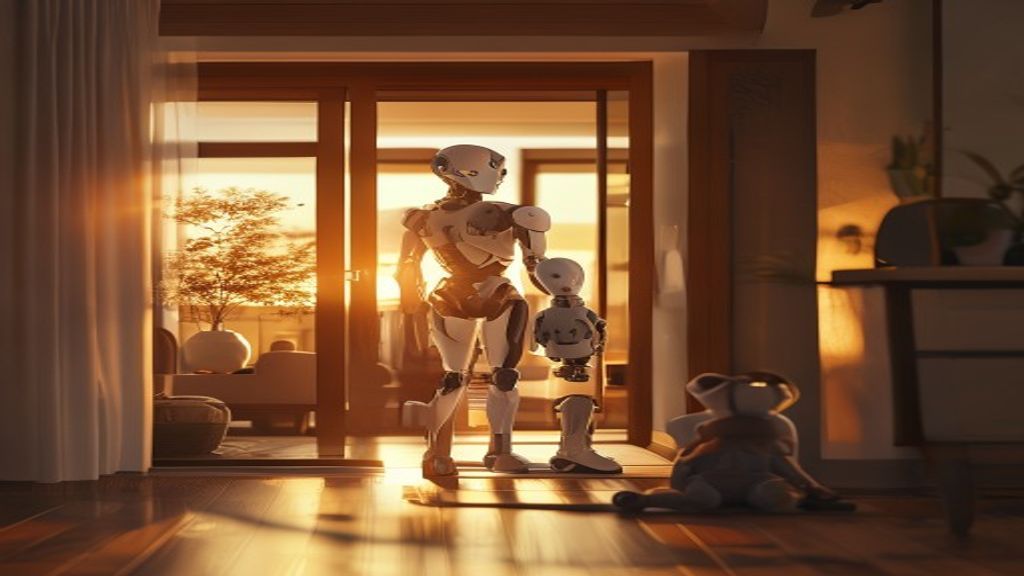
Lifelike Humanoid Robots Entering Homes: Trust vs. Safety
Before Humanoid Robots Enter Our Homes: Trust or Safety First?
Humanoid robots are transitioning from factories, exhibition halls, and laboratories into a far more complex environment: the home.
Industrial robots are measured by production-line tempo, workstation safety, and efficiency metrics. Home robots, by contrast, must navigate elderly family members, children, pets, private spaces, emotional companionship, and the endless unpredictability of daily life. Whether a robot can cross the threshold into our homes is no longer just a technical question, nor merely one of price — it is fundamentally about safety, boundaries, and trust.
Consider UBTech, a company that has long made “bringing intelligent robots into every household” its core mission. Its Walker product literature describes systems equipped with force, visual, auditory, and spatial perception capabilities, enabling movement and service delivery in both home and office settings. More recently, UBTech introduced a companion robot with a more lifelike appearance. Public information indicates that its U1 series targets companionship and emotional support applications, with the top-tier version priced at up to 990,000 RMB.
This signals that humanoid robots have moved beyond the question of “can it lift boxes?” They are now entering a far more sensitive territory: whether robots can serve as long-term companions to family members.
The Home Is Not a Factory — Risks Are More Nuanced and Harder to Define
In a factory, robots can be constrained by safety fences, designated workstations, standardized procedures, and operating protocols. Even humanoid robots deployed on production lines can have their range of motion, task objectives, and personnel clearance distances strictly defined. Figure AI previously disclosed that its Figure 02 robot underwent an 11-month deployment at BMW’s Spartanburg plant in the United States, accumulating over 1,250 hours of operation, loading more than 90,000 parts, and contributing to the production of over 30,000 BMW X3 vehicles. This case illustrates that international humanoid robotics companies currently prefer to validate stability and reliability in industrial settings first.
The home is a different matter entirely. There are no standard workstations, no fixed routes. Toys may be scattered on the floor, hot water may be sitting on a table, an elderly person may stand up suddenly, a child may approach the robot out of curiosity, and a pet may interfere with its movement. Once a robot enters a household, it must contend with a vast array of non-standard, unpredictable, and unstructured situations.
This is precisely what makes lifelike humanoid robots more sensitive than robot vacuums. A robot vacuum operates close to the ground with clearly defined functional boundaries. A humanoid robot, however, has hands, feet, cameras, voice interaction capabilities, and may even be tasked with companionship and caregiving duties. The more human-like it appears, the more likely family members are to treat it as a “person” — yet in terms of legal responsibility, it remains a machine.
Risk One: Privacy Boundaries
The home is the most private of spaces. For a robot to perform household tasks effectively, it must “see” the room, “understand” commands, “remember” object locations, and even recognize the habits of family members. These capabilities make the robot more useful — but they also complicate privacy boundaries considerably.
Similar debates have already emerged in the international market. 1X Technologies’ NEO is positioned as a home robot. According to the company’s website, NEO uses Redwood AI to learn and repeat tasks. For more complex tasks, 1X specialists can remotely supervise the robot’s actions during scheduled appointments, helping it acquire new capabilities.
This “human-in-the-loop” design serves a practical purpose, as today’s robots are far from fully autonomous. But it also raises a critical question: when remote assistance enters the home, could external personnel potentially observe the domestic environment? How is data stored? Which rooms, which time periods, and which family members can be excluded from monitoring? The OECD.AI risk registry notes that NEO has raised privacy concerns due to its cameras, microphones, and remote operation mechanisms — though the registry emphasizes that these discussions involve potential risks, not actual harm that has already occurred.
For Chinese companies, this point demands particular attention. If lifelike robots are to enter homes, they cannot merely emphasize “emotional companionship” and “household capabilities.” They must also clearly specify: what data the robot collects and what it does not; where data is processed; when remote services are activated; how users can perform a one-tap shutdown; and how data related to children and the elderly is protected.
Risk Two: Physical Safety
Safety in home robotics extends far beyond “will it fall over?” The more pertinent question is whether the robot might mistakenly grab, bump, push, or execute an action in an inappropriate context.
A gentle bump may be harmless to a healthy adult, but elderly individuals, children, and pets have very different tolerances. Pouring hot water, handling a knife, moving a chair, or helping an elderly person stand up — these seemingly ordinary household tasks all involve force control, speed modulation, posture management, environmental awareness, and clearly defined lines of responsibility.
1X’s NEO emphasizes a soft exterior and dexterous hands. Wired reported that its hand features 25 degrees of freedom — approaching the 27 of a human hand — and can assess grasping scenarios through cameras and AI. The company also stresses safety, compliance, and suitability for coexistence with ordinary people.
Yet the more dexterous a robot becomes, the more boundaries it requires. Home robots should not be granted excessive autonomy from the outset. Which actions may only be performed after adult confirmation? Which areas are off-limits? Which objects must not be touched? Which tasks must be executed at low speed and low force? These constraints should be built into the product design from the beginning — not relegated to after-sales terms following an incident.
Risk Three: Emotional Dependency
The most fundamental difference between a lifelike robot and an ordinary home appliance is that the robot may be designed to be “human-like.” It can speak, remember preferences, respond to emotions, and even possess facial expressions and skin textures that approximate a human face. The UBTech U1 series sparked discussion precisely because it placed “emotional companionship” at the center of its product narrative.
Such products could have genuine positive impact for elderly individuals living alone, those requiring specialized care, and people seeking emotional support. Research also suggests that teleoperated home robots in certain assisted scenarios may help individuals with limited mobility perform self-care and household tasks, thereby enhancing independence.
On the other hand, robotic companionship cannot replace genuine human relationships. For the elderly and children in particular, if a robot is excessively anthropomorphized, users may mistake machine-generated responses for authentic emotion. If companies lean too heavily on marketing concepts like “cyber companion” or “family substitute” in their promotional efforts, they risk crossing ethical boundaries.
Home robots can serve as assistants, tools, and providers of limited companionship — but they should not be packaged as replacements for intimate human relationships.
Risk Four: Accountability
When a robot malfunctions in the home, who bears responsibility?
If it knocks over a vase, is it user error or an algorithmic flaw? If a mistake occurs during a remote-assistance session, is the service operator, the platform company, or the hardware manufacturer liable? If a software update alters the robot’s behavior, does the user have the right to be informed and to opt out?
In a factory setting, these questions can still be addressed through contracts, procedures, and insurance. In the home, however, the lines tend to blur. What a consumer brings home is not an ordinary appliance but an intelligent device that can perceive, move, learn, and update itself.
Therefore, before lifelike robots enter households, clearer product classification is essential. Companion-type, housework-type, caregiving-type, and medical-assistance-type robots should not be conflated under a single marketing umbrella. Different functions should correspond to different safety standards, data requirements, and accountability mechanisms.
UBTech’s Opportunity Lies in Boundary-Setting
From an industry perspective, UBTech’s advantage lies in its early entry into the humanoid robotics field and its coverage across education, service, industrial, and companion applications. The company represents a Chinese robotics firm’s journey from “building robots” to “integrating robots into daily life.”
Yet precisely because of this, UBTech has an even greater need to establish boundaries in the home robotics space. More human-like is not inherently better. More conversational is not inherently better. Greater access to private spaces is certainly not inherently better. A truly sustainable home robot must first prove that it is safe, restrained, capable of being shut down, and transparent in its operations.
International companies are facing the same test. 1X’s NEO has brought home robots to the consumer frontier, but the privacy debates surrounding its remote operation capabilities serve as a reminder to the industry: current technology still requires humans in the loop, and where humans are in the loop, institutional boundaries must follow. Figure’s decision to validate first at a BMW plant demonstrates another, more cautious path: accumulate reliability in controlled environments before gradually entering more complex spaces.
Bot Telegraph Assessment
The entry of lifelike robots into the home will not be settled by a single product launch, nor by price alone. It requires answers to four fundamental questions: What can the robot see? What can it do? Who is responsible when something goes wrong? And can the user say “no” at any time?
The UBTech case demonstrates that Chinese companies already possess the capability and ambition to bring humanoid robots into everyday life. The examples of international firms like 1X and Figure, meanwhile, remind the industry that domestic deployment cannot skip the thresholds of privacy, safety, ethics, and accountability.
What home robots must ultimately win is not a moment of curiosity, but the test of long-term coexistence. A robot in the home must do more than inspire wonder — it must inspire trust.
The first step for robots entering the home is not to become more human, but to better understand boundaries.